A Flat Carbon Commutator is a small component with a demanding job: it transfers current between stationary brushes and a rotating armature. In motors used for appliances, power tools, and industrial equipment, its carbon grade, copper segments, dimensions, and balance can affect wear and operating stability. Small parts matter.
The International Energy Agency’s 2011 report, Energy-Efficiency Policy Opportunities for Electric Motor-Driven Systems, estimates that motor-driven systems consume about 45% of global electricity. This figure describes broad energy use, not commutator sales. Still, it helps explain why dependable motor components remain important across many industries. It does not identify the leading suppliers.
This overview examines China-based manufacturers offering flat carbon commutators. It considers product range, customization, production capability, quality controls, and the technical information companies make available. Practical checks include segment count, shaft dimensions, carbon-brush compatibility, and sample inspection. A polished website is not proof of consistent production. A ranking alone is imperfect, too, because supplier performance depends on the application and verification method. Buyers should confirm current specifications directly and assess samples against their own requirements. The list is a starting point, not a substitute for engineering review.
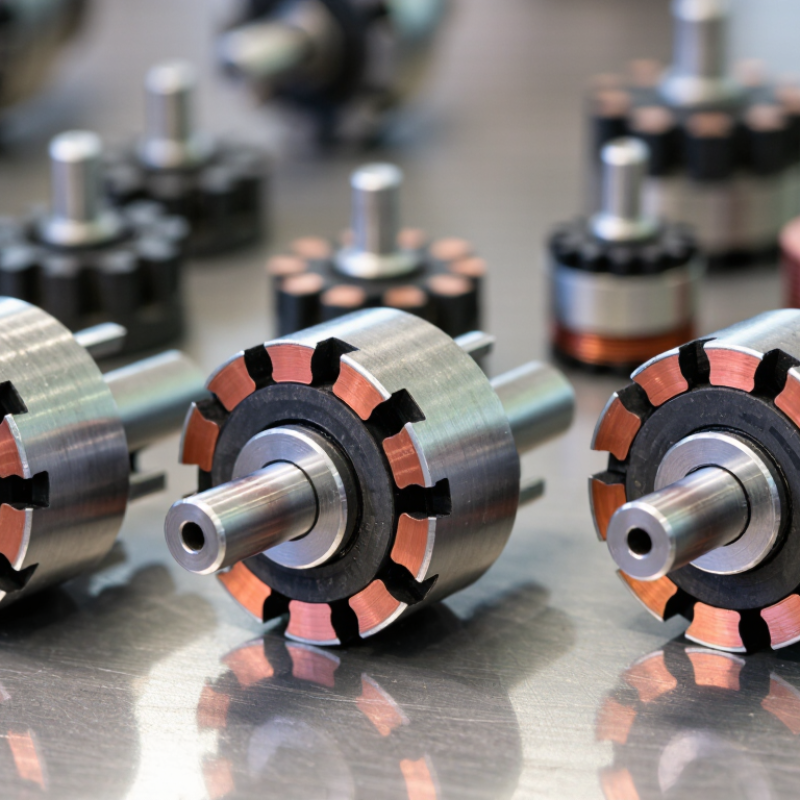
A flat carbon commutator is a low-profile rotating contact assembly used in some brushed electric motors. Its conductive sections connect to the rotor windings and sit beside one another across an insulated surface. As the rotor turns, stationary carbon brushes press against that face. The contact shifts between sections, redirecting current through the windings and helping maintain rotation. In a small motor, this motion happens rapidly. The switching is mechanical, not electronic.
The flat shape can suit compact motor layouts where axial space is limited. Yet its performance depends on more than dimensions. Brush pressure, surface finish, current load, and heat all affect contact quality. Uneven wear may cause sparking, noise, or speed changes. A clean diagram makes the operation look simple; real wear patterns can be less tidy. That is worth checking during maintenance.
Tips: Confirm the commutator’s dimensions and electrical rating against the motor specification. Look for pitting, dark deposits, or uneven brush wear. A little discoloration may be normal, but persistent sparking needs investigation. Do not assume every flat design uses the same carbon grade or segment layout.
China’s flat carbon commutator manufacturing landscape spans specialist workshops and larger electrical-component factories. Their capabilities differ in tooling, batch size, inspection methods, and support for custom drawings. Many produce pressed carbon segments, metal hubs, and assembled commutators for motors used in appliances, tools, and industrial equipment.
Production quality depends on more than a clean finish. Buyers should check dimensional tolerances, segment spacing, insulation, hub fit, and commutator runout. Details matter. Carbon grade and brush compatibility also affect wear, heat, and electrical contact. Ask for inspection records and sample measurements, then compare them with the approved drawing. Testing helps.
Supplier evaluation takes practical judgment. A polished catalog does not prove consistent production, while a smaller workshop may have capable technicians but limited documentation. Request a sample batch and confirm how defects are recorded, corrected, and traced. Lead time, tooling ownership, and minimum order quantities can vary considerably. These points deserve written clarification before production begins. The landscape is broad, and no single factory suits every motor design.
Criteria for Comparing Chinese Commutator Manufacturers
When comparing Chinese manufacturers of flat carbon commutators, look beyond quoted price and catalog photos. Check whether the supplier can hold the specified outer diameter, bore size, segment count, and runout tolerance. Ask for material details, including carbon grade and copper segment composition. Request inspection records for insulation resistance, dimensional checks, and dynamic balance where relevant. Evidence matters. A polished brochure alone cannot establish production consistency.
Tips: Send the same drawing and operating conditions to each candidate. Compare written responses, not just prices. Ask how samples are measured and how production changes are controlled. Small details count.
A useful evaluation also covers tooling, traceability, lead times, and communication during design changes. Request a sample made to your drawing, then inspect it with suitable measuring equipment before approving volume production. Check whether the maker explains limits clearly, rather than promising every tolerance without qualification. One imperfect point: supplier questionnaires can make different factories look more similar than they are. Follow up with specific questions about failure analysis, corrective actions, and repeat-order inspection. Use your own application testing to confirm fit and performance.
| No. | Comparison criterion | Data to request | Unit or evidence | How to compare fairly |
|---|---|---|---|---|
| 1 | Product construction and drawing conformity | Commutator type, segment layout, overall dimensions, mounting features, and approved drawing revision | Dimensioned drawing; mm; revision identifier | Compare suppliers against the same customer-approved drawing and revision. Do not assume “flat carbon commutator” describes one universal construction. |
| 2 | Dimensional accuracy | Measured dimensions and specified tolerances for critical features, such as outside diameter, bore, thickness, and mounting dimensions | mm; inspection report; measuring method | Use identical measurement locations and tolerances for every quotation. Tolerances should come from the application drawing, not an assumed industry-wide value. |
| 3 | Runout and concentricity | Radial and axial runout at the specified reference surfaces | mm; inspection report; stated datum and setup | Compare results only when suppliers use the same datum, fixture, and measurement procedure. |
| 4 | Conductive and insulating materials | Segment conductor material and grade; insulation material and grade; material certificates where applicable | Material specification; certificate or test record | Check that the offered materials match the approved specification and operating conditions. Material names alone do not establish equivalent performance. |
| 5 | Electrical characteristics | Resistance or voltage-drop limits, insulation resistance, and any specified withstand-test requirements | Ω, mΩ, or V as specified; test conditions and report | Compare measurements made at the same temperature, test points, test voltage, and acceptance limits. |
| 6 | Operating suitability | Intended current, voltage, rotational speed, temperature range, duty cycle, and compatible brush or contact arrangement | Application limits; product datasheet; test evidence | Assess against the actual motor or equipment requirements. Do not treat a rating as comparable unless its test conditions and configuration are stated. |
| 7 | Mechanical integrity and balance | Specified mechanical-strength checks and, where relevant, balance requirements for the rotating assembly | Test method; acceptance criteria; balance grade if specified | Request evidence relevant to the finished assembly and its operating speed. Apply the same customer-defined criteria to each supplier. |
| 8 | Manufacturing and process controls | Documented production steps, in-process checks, equipment maintenance, and control of process changes | Process flow; control plan; audit records | Compare the documented controls and their application to the quoted product, rather than relying on general capability statements. |
| 9 | Inspection, traceability, and nonconformance handling | Lot identification, inspection records, sampling plan, nonconformance procedure, and corrective-action process | Sample inspection report; traceability example; quality-system records | Check whether a delivered lot can be traced to its material and inspection records, and whether defects are handled through a documented process. |
| 10 | Commercial and delivery terms | Quoted price, minimum order quantity, tooling charges, sample lead time, production lead time, packaging, and delivery terms | Written quotation; quantity and delivery schedule | Compare quotations at the same order quantity, specification, packaging level, delivery location, and payment or trade terms. |
| This table is a supplier-comparison framework, not a verified ranking of manufacturers. Request current drawings, test reports, and quotations for the specific part before making a technical or purchasing decision. | ||||
A useful China-focused comparison of flat carbon commutator manufacturers should examine capabilities, not rely on a ranking alone. These ten profiles describe supplier strengths to verify, rather than independently confirmed company claims. Details matter.
One profile specializes in accurate carbon cutting, with clean edges and consistent thickness.
Another offers several carbon grades for differing current and wear conditions.
A third focuses on copper segments, checking spacing and surface finish.
A fourth integrates carbon and copper assembly, where bonding quality can affect service life.
A fifth supports custom dimensions for compact motors.
A sixth emphasizes batch consistency, using inspection records to compare production runs.
A seventh provides application guidance, though buyers should confirm its recommendations with operating data.
An eighth profile offers testing for resistance, runout, and contact stability. A ninth prioritizes short production runs and prototype adjustments. A tenth focuses on export-ready packaging that protects delicate contact surfaces.
These distinctions are practical starting points, not proof of performance.
Request drawings, material specifications, sample measurements, and traceable quality documents. Ask how results are recorded, too. Supplier descriptions can sound precise while leaving test conditions unclear. That gap deserves attention. Compare samples under the intended load and speed before choosing a production partner.
Flat carbon commutators serve brushed motors in power tools, household appliances, vehicle actuators, and compact industrial drives. Application matters: a tool exposed to dust and sudden load needs different wear behavior from a quiet appliance motor. The IEA’s Energy Efficiency 2023 report estimates that electric motor systems account for about 45% of global electricity use. Not every motor uses a commutator, but the figure shows why dependable motor components matter. Small errors add up.
For supplier evaluation, request dimensional records for bar height, outside diameter, concentricity, and runout. Check carbon grade, copper-bar bonding, insulation condition, resistance consistency, and wear testing against the intended brush and duty cycle.
ISO 9001 can indicate controlled production processes; IEC 60034 provides a motor-level framework, but neither sets every commutator acceptance limit. Define those limits in the drawing and inspection plan. A clean certificate is not enough. Ask for sample test results and traceability from batch to shipment.
A ranking based only on paperwork is a weak shortcut; I would give equal weight to process evidence and application testing. One detail is often overlooked: ask how the supplier handles changes in raw-material batches, since small shifts may affect brush wear and temperature.
It is a low-profile rotating contact assembly used in some brushed motors. Its conductive sections connect to the rotor windings.
Stationary carbon brushes touch the rotating surface. As contact shifts between sections, current is redirected through the windings.
Its shape can fit compact motors with limited axial space. The fit still depends on the motor’s layout.
Brush pressure, surface finish, electrical load, and heat all matter. Small differences can affect contact.
Look for pitting, dark deposits, uneven brush wear, or persistent sparking. A little discoloration may be normal.
Match dimensions and electrical ratings to the motor specification. Also check the carbon grade and segment layout; they can vary.
Request sample measurements, inspection records, and a sample batch. A polished catalog alone proves little.
Confirm lead time, tooling ownership, minimum order quantity, and defect-tracking methods in writing. Some details are easy to miss.
This article explains what a Flat Carbon Commutator is and how it transfers electrical current between stationary and rotating parts of a motor. It outlines the structure and operating principles of flat carbon commutators, then introduces China’s manufacturing landscape, including common production capabilities, product variations, and the factors that shape supply.
The article also presents a framework for comparing ten notable manufacturers without relying on brand names, considering factors such as engineering expertise, manufacturing capacity, customization, quality control, and delivery support. It reviews typical applications and relevant quality standards, then offers practical guidance for supplier selection. By weighing technical requirements, product consistency, testing practices, and after-sales service, readers can make a more informed assessment of potential suppliers and choose a commutator suited to their equipment and operating conditions.